Birds of Conservation Concern
Fifteen percent of species that regularly occur in Canada are designated in some level of risk category by the Committee on the Status of Endangered Wildlife in Canada (COSEWIC). These species require extra efforts to restore their populations to healthy levels and to ensure their long-term conservation. Special attention is also needed for species showing marked declines, which may become at risk if prompt action is not taken.
The percentage of bird species that are designated as at risk by COSEWIC, or are showing large decreases varies geographically across Canada. The highest proportions of species at risk are in the regions most heavily impacted by human activities: the Lower Great Lakes / St Lawrence, the West Coast and Mountains and the Prairies. The Arctic also has a high percentage of species of concern, due partly to changes happening outside the Arctic—habitat loss and degradation along their extended migration routes and in southern-hemisphere wintering areas.
Protecting Species at Risk
Loggerhead Shrikes have declined throughout their
range in Canada and are now considered Endan-
gered. Captive breeding is being undertaken with
some success, but releasing individuals into the
wild is challenging, as the original threats are
still not fully understood and addressed. (photo:
May Haga)
Since 2001, when COSEWIC adopted its current criteria for assessments, the number of birds designated as at risk has increased. This partly reflects improvements in our knowledge—better information, more species assessed and greater awareness of imperilled species—but also real declines in the status of some of Canada’s bird species.
An index of changes in the status of COSEWIC-designated species over time, after they are designated, indicates that, on average, status improved (values > 100) between the late 1970s and the late 1990s. Many species assessed during the earlier time periods had declined as a result of toxic pesticides such as DDT. Banning of DDT, combined with concerted conservation efforts, such as re-introduction programs and artificial nest-boxes and platforms, helped some species recover. Since the 1990s, the average status of species at risk has worsened. Many species are threatened by complex combinations of factors that are poorly understood and that make quick recovery unlikely.
The Wood Thrush, well known for its ethereal,
flute-like song, was formerly one of the most
common forest birds in eastern North America,
but the Canadian population has decreased by almost
70% in the last 40 years. Prompt conservation action,
including conserving habitat in its breeding range
and its wintering grounds in Central America is
needed to reverse the trend to ensure it is never
designated as a species at risk. (photo: Isaac Sanchez)
Prevention is better than a cure
It is much more cost effective to take action early, to prevent species from becoming at risk, instead of requiring emergency action to recover endangered species. Special attention is needed for bird species showing substantial population declines which have not yet reached critical status. Bird conservation planning (see page 28), focussed on these priority species, can help to identify the most effective ways to manage the landscape to ensure conservation of species before they become threatened or endangered.

Piping Plover. (Photo: Gordon Court)
The Piping Plover: Land-use conflicts across its range
In all parts of their range, Piping Plovers depend on habitat that is highly desirable for people: beaches in eastern Canada and their wintering grounds; and lakes, ponds and other water sources in the Prairies. On their breeding grounds, threats include accidental disturbance and nest destruction by beach users and predation by cats and other predators such as crows and gulls. In their wintering areas, many beaches are being developed into tourist resorts to support the local economy. Cooperative international efforts that balance economic development with the habitat requirements of Piping Plovers are needed to help recover this endangered species.

The Ivory Gull was designated as a species of Special Concern in 2001, but by 2006 due to ongoing declines, the status was reassessed as Endangered. Only 500–700 adults are thought to remain in Canada. (photo: Alan Burger)

Whooping Cranes. (Photo: © Parks Canada/Klaus Nigge)
The Whooping Crane: a success story
Although the problems of bird conservation can seem daunting, the dedication and concern of Canadians, in cooperation with partners throughout the Americas, have led to some successes. By 1938, the Whooping Crane population had declined to only 15 individuals due to a combination of hunting and habitat loss. Intensive management in both the United States and Canada has included habitat protection, a captive breeding program, creation of new wild populations and the use of ultra-light planes to teach migration. By 2011, numbers had increased to over 430 in the wild (including introduced populations) and another 160 in captivity. While the Whooping Crane is still considered endangered and remains one of the rarest birds in North America, these efforts are gradually pulling this magnificent bird away from the brink of extinction.
Where have all the swallows gone?
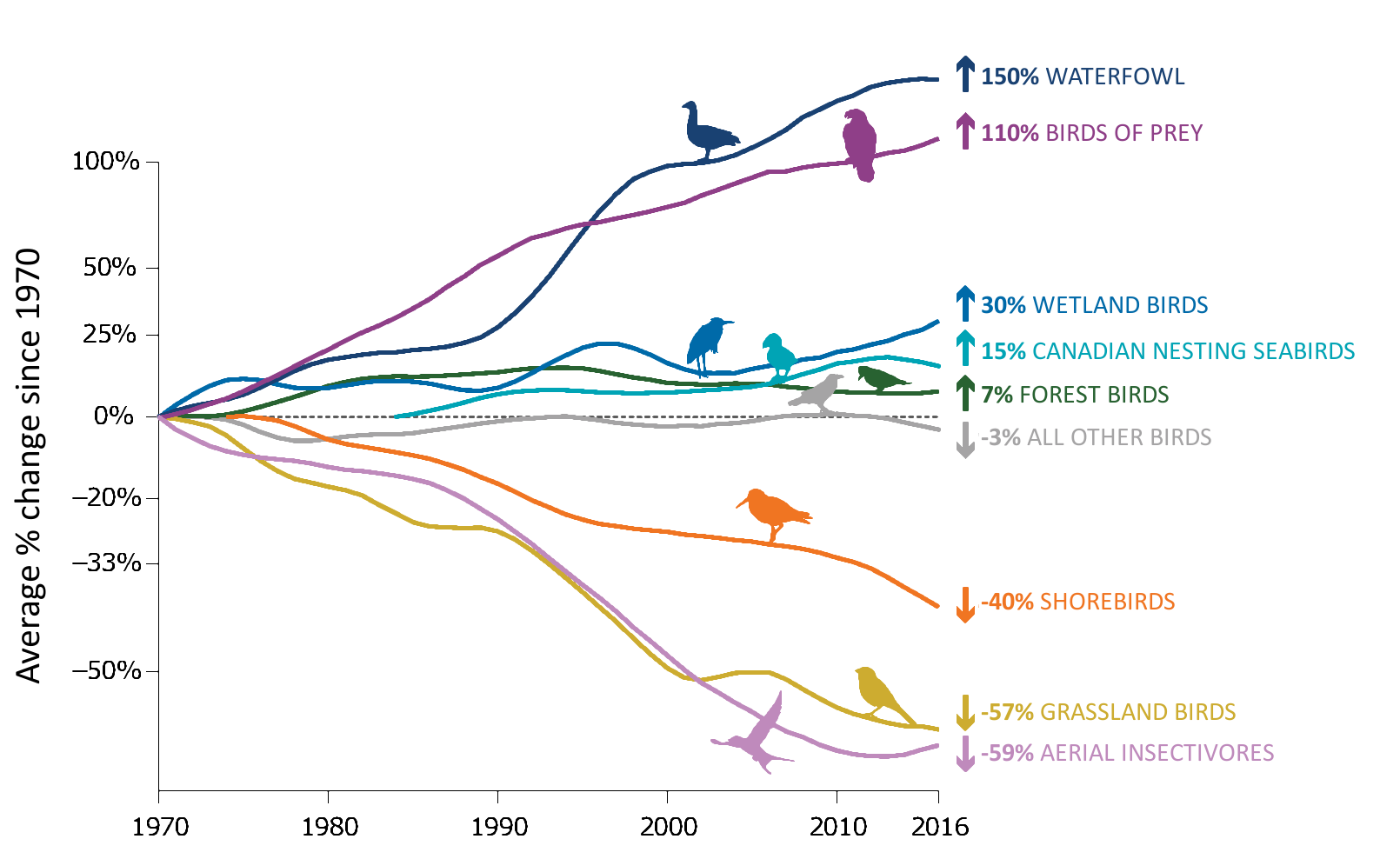
Aerial insectivores are birds that specialize in a diet of flying insects. Populations of these birds have decreased more than any other group in Canada. Twenty-two of the 26 species that breed in Canada are declining, with swifts, swallows and nightjars—Common Nighthawk and Eastern Whip-poor-will—showing the most alarming changes.

Cliff Swallows have declined as have many other
swallow species. Most colonies are now found on
human structures such as buildings and bridges,
and need to be protected. (Photo: Charles M.
Francis)
We don’t yet know why aerial insectivores are showing such steep declines. These birds depend entirely on flying insects for food and any decrease in flying insects from pesticides or other contaminants—in Canada, along migration routes or in their wintering grounds—could have a large impact on survival. Even a minor shift in the seasonal timing of insect emergence due to climate change, could result in mismatched seasonal cycles of birds and their insect prey that could be disastrous for species with no alternative food source. For some aerial insectivores, such as Chimney Swift and Barn Swallow, human-made nesting sites are no longer as widely available (e.g., open chimneys and wooden barns), and habitat for some shrub and open-nesting species has also declined. However, for other species there have been no obvious changes in breeding habitat. Further research is urgently needed to identify the causes of these declines so that appropriate conservation action can be taken to reverse them.

Olive-sided Flycatchers breed around wetlands
across the Boreal forest. Their populations
have declined dramatically, and they are now
designated as Threatened, though the causes of
their decline are not understood. (photo: Nick
Saunders)

Changes in flying insect populations are poorly
understood but may be partly responsible for
declines in aerial insectivores. (photo: Harvey
Schmidt)