Conserving Canada's Birds
Ensuring healthy populations of all species of Canada’s birds requires a concerted effort by all levels of society including government, non-government organizations, the scientific community, the commercial-industrial sector and individuals. It requires working in Canada as well as internationally with countries that share our birds. From developing appropriate policy and legislation, to providing the scientific foundation for conservation through population monitoring and research, to education, to preparing and implementing management plans, to on-the-ground conservation actions, everyone can contribute to bird conservation.
Foundations of bird conservation in Canada
At the end of the 19th Century, many species of North American birds had been hunted almost to extinction. Increasing awareness of their plight led to national and international protections, including the Migratory Birds Convention, signed by Canada and the United States in 1916. Although too late for some extinct species such as the Passenger Pigeon, Great Auk and Labrador Duck, this convention has provided the foundation for nearly a century of international cooperation on bird conservation. Commercial harvesting of birds was banned, and careful regulations have helped to ensure sustainable recreational hunting in both countries. Many species, such as herons, egrets and waterfowl, recovered dramatically after protection.

Egrets were hunted nearly to extinction by the early 1900s to meet demand for
their feathers in ladies' hats, but since protection, their populations have
recovered. (Photo: Mark Peck)
Protected Areas in Canada

Cobourg Island is one of several National
Wildlife Areas in the Arctic, established to
protect large seabird colonies. (Photo: Grant
Gilchrist)

The dedication of volunteer IBA
Caretakers helps maintain the value
of IBAs. (Photo: Carla Ahern)
Important Bird Areas: International avian hotspots
BirdLife International has developed a set of global criteria for identifying Important Bird Areas (IBAs)—areas of particular importance to one or more species of birds at some stage of their life cycle. Bird Studies Canada and Nature Canada, have identified nearly 600 IBAs in Canada. The majority are sites where large numbers of birds regularly breed, congregate or pass through on migration; others were identified because they are particularly important to one or more species at risk.
Designation as an IBA provides no official protected status, but instead highlights the area as particularly important to birds and encourages opportunities for conservation. Once identified, IBAs can be considered as candidate sites for formal protection and considered in land and water-use planning. They are also being supported by a Caretaker program, which engages local individuals and organizations to help monitor bird populations, collect information on threats to birds within the IBA, restore habitat as needed, and educate and advocate for the birds that use the IBA.

Proportions of Canadian IBAs covered by protected areas
Almost 70% of Canada’s IBAs have little or no formal protection—none or a small portion of the IBA overlaps a protected area. Of the IBAs that do overlap, only half are in protected areas where conservation is the primary focus, such as national parks and conservation reserves. The remainder occur in areas that allow a wider range of human activities including development. Many activities are compatible with birds, including hunting, well-managed farming, and many types of recreational pursuits. However, some industrial activities may be incompatible with IBAs, particularly if they destroy key habitat features, increase the risk of environmental contamination, or create major risks to birds. Careful land-use planning is needed to ensure the values of each IBA are conserved.
Conservation in the working landscape
Conservation of viable and healthy populations of birds requires not only protected areas, which collectively cover only a small portion of the landscape, but also conservation in the remaining “working” landscape—areas where human activities and nature interact. In general, what is good for birds is good for people. Sustainable resource use, clean air and clean water lead to a healthy environment for birds and people.
Most species of Canada’s birds can cope with moderate levels of disturbance and a variety of habitat alterations—within limits. Human activities, ranging from resource extraction to agriculture to urban development, can be done in ways that minimize negative impacts on the environment and help to sustain healthy bird populations.

North America is divided into 66 Bird Conservation Regions
Bird Conservation Planning
Environment Canada, on behalf of NABCI-Canada, is leading development of bird conservation plans for each of Canada’s 12 Bird Conservation Regions (BCRs), in collaboration with similar efforts in the United States and Mexico. These plans identify the priority bird species for each region, as well as their key habitat requirements, specific threats and the activities needed to address the threats. The plans will provide a basis for a comprehensive approach to managing Canada’s land and resources that benefits birds and the overall environment.
Forestry
Canada’s forests are naturally dynamic—wind storms, insect outbreaks, disease and fire continuously change them. Forests are adapted to regenerate and recover from disturbances and Canada’s birds have evolved to live in these dynamic landscapes.

Forestry operations that emulate natural
disturbances can meet society's need for wood
and paper products, while supporting diverse
bird communities. (Photo: Charles M. Francis)
Agriculture

Hayfields provide excellent nesting habitat
for many grassland birds, as long as cutting
of the hay is delayed until after young birds
have left their nests. (© Photos.com – 2012)
Mining, Oil and Gas

Pipelines must be carefully routed to minimize
damage to natural habitats and reduce the risk
of spills. (Photo: Laurie Buckland)
Urban and Industrial Development

Northern Cardinals have adapted well to
city environments, and enrich the lives of
people living there. (Photo: Joel Campbell)
Addressing Other Threats to Birds
Tens of millions of birds die each year across Canada from collisions with windows, tall buildings, transmission towers, power lines, vehicles and other structures. Although this mortality cannot be completely eliminated, the risks can be reduced. Turning off building lights at night during the migration season not only reduces mortality to birds, but also saves energy. Ultraviolet reflective markings on windows help birds to avoid them. Reducing the height of transmission towers, avoiding guy wires, and using strobe lights instead of steady burning lights reduces risks to birds. Policies that encourage different companies to share the same towers would reduce the total number of towers needed.

Feral cats and domestic cats allowed outdoors kill more
birds than any other human activity. (Photo: Will
Keightley)
Fisheries kill some seabirds but some relatively simple and effective solutions exist, such as using streamers and other visual distractions to keep birds away from baited longlines, weighting longlines to ensure they sink quickly beyond the birds’ reach and setting nets away from areas where seabirds are known to concentrate.
Chemical pollution—pesticides, oil spills, heavy metals, etc.—kill birds outright and have more chronic effects on bird health, survival and their ability to reproduce. Strategies to reduce emissions, minimize risks of spills and use fewer, less toxic pesticides will benefit both birds and humans.
Climate Change

In 2005, Hurricane Wilma carried millions of
migrating birds off-course, some being blown
across the Atlantic to Europe. Many of these
birds died, including many Chimney Swifts,
which declined by 50% in Quebec breeding
surveys the next year. (Photo: Tony Beck)
Climate change is already having measurable effects on bird populations through mortality during severe weather events, mistimed insect emergence, disappearing Arctic ice, changing ocean temperatures and collapsing food-webs; and many more effects are predicted. Reducing these threats requires urgent action to prevent further climate change and to mitigate and adapt to the effects that are inevitable, by implementing land-use and conservation plans that account for the added threat and uncertainty.

Peregrine Falcon populations have recovered
due to a combination of reduced pesticides and
active release of captive bred individuals in
areas where populations had disappeared.
(Photo: Gordon Court)
Intervention yields results: Raptors in recovery
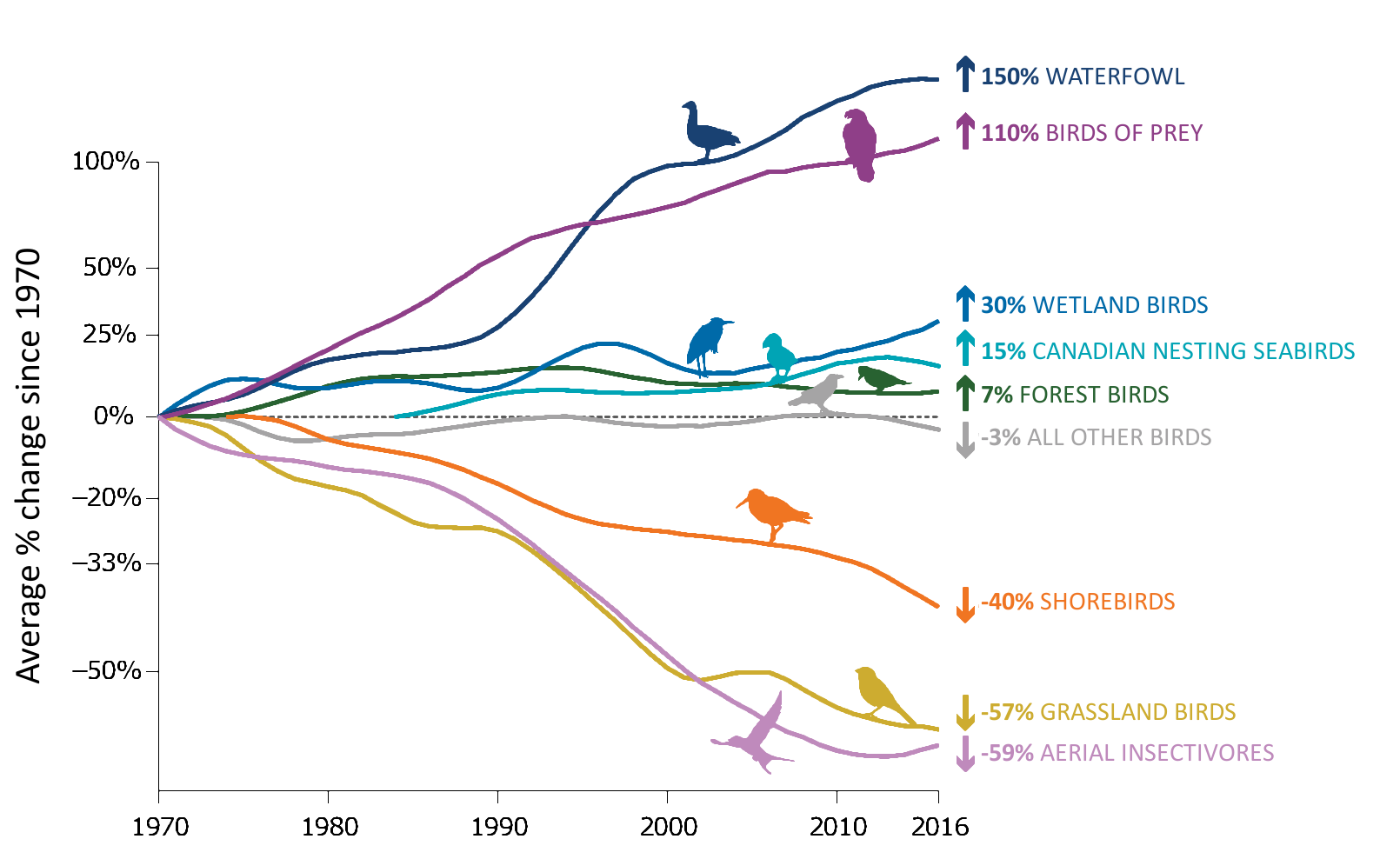
One of the great success stories for bird conservation is the continuing recovery of many raptors (i.e., hawks, falcons, eagles, osprey and vultures) since the banning of chemical pesticides such as DDT in the early 1970s. Across Canada, Ospreys and Bald Eagles have doubled or tripled in population. Thanks in part to some intense efforts at captive breeding, many major Canadian cities now have Peregrine Falcons nesting on skyscrapers and bridges. These recoveries are a testament to the power of strong controls on key environmental pollutants and hands-on management of endangered species to improve the plight of birds. These steep recoveries also point to the profound effects that DDT had on these birds.

The Cooper's Hawk is one of several raptor
species that are increasingly adapting to
urban environments. (Photo: Mark Peck)
Many raptors are adapting to urban environments. Peregrine Falcons, Merlins, Cooper’s Hawks, and Broad-winged Hawks are becoming more common in urban and suburban environments—partially due to relatively dense populations of prey species, such as the non-native European Starling.
As a group, raptors are increasing but not all species have fared equally well. American Kestrels and Northern Harriers, for example, have declined by 60%. Both species depend on open grassland and farms and are affected by many of the same threats as other grassland birds. Swainson’s Hawks are known to be vulnerable to poisoning from pesticides in South America.
What can one person do?
"Never doubt that a small group of thoughtful, committed citizens can change the world. Indeed, it is the only thing that ever has." (Margaret Mead)

There are many opportunities for volunteers
of all ages and with a variety of skills to
help with bird conservation projects, such as
repairing nest boxes in a conservation area.
(Photo: Peter Ward)
The actions of society are determined by the actions of individuals. The choices we make and the activities we undertake collectively make a difference to birds. There are many things that we can do as individuals to improve the environment for birds and people. Some choices benefit bird populations directly, such as keeping cats indoors and choosing products that support bird-friendly agricultural, fisheries and forestry practices—shade-grown coffee, range-fed meat, sustainable seafood and fish and sustainable forestry products. Reducing our resource consumption, increasing recycling, taking public transport or bicycling to work and driving fuel efficient cars all lead to environmental benefits, including reduced greenhouse gas emissions, that ultimately benefit birds. We can help birds even more by supporting bird-friendly policies. Learn about the environmental policies of each level of government and how they will affect birds. Share your views with others through letters to newspapers, community meetings and social media.

Engaging children in Citizen Science programs, such as eBird,
the Christmas Bird Count and Project FeederWatch, provides
an opportunity for them to have fun outdoors, contribute to
a valuable scientific program and learn to appreciate the
environment. (Photo: Catherine Jardine)
You can also contribute to bird conservation by supporting your local naturalist groups and other conservation organizations. You can learn more about birds and other wildlife by participating in their meetings or organizing field trips with other interested people. Working with children is especially rewarding, by teaching them to experience and appreciate the natural world, and support conservation in the future. Learning more about birds also opens the opportunity to join the rapidly growing numbers of Citizen Scientists who participate in bird surveys. If you enjoy identifying birds, there are opportunities for everybody, from beginners to experts.